1. What is the difference between city water and well water?
City water is pre-treated to make sure it is free of bacteria, viruses and common contamination sources. City water is regulated so that the contaminants regulated by the EPA fall within or below EPA guidelines. Well water is untreated water from an underground aquifer that is pumped into a house. Well water may contain higher than average levels of iron or sulfur, or other contaminants.
3. What is hard water?
Hard water contains a higher than average amount of dissolved minerals (primarily calcium and magnesium), and a higher concentration of multivalent cations (Ca2+ and Mg2+). Hard water is mostly a nuisance as these dissolved minerals can clump together to produce scale, which can harm your internal pipes, plumbing, and home appliances.
4. Does having hard water mean it is contaminated?
No, hard water is more of a nuisance than a health issue, and is not considered contaminated. Most water sources in the USA are considered hard. Is hard water safe to drink? Yes, hard water is healthy enough to drink.
5. What is soft water?
The most recognizable trait of "soft" water is how much more soap lathers, as opposed to hard water, in which soap lathers less due to the higher concentration of minerals. Water softeners reduce the negative effects of dissolved minerals in water that can clump together and produce scale buildup.
6. Does having soft water mean it is clean water?
Soft water does not mean clean water. Your water can be soft and still have contaminants present in the water. Is it safe to drink? Yes, soft water is considered potable as long as the water has not passed through a sodium-based water softener. Drinking water from a sodium-based softener increased your daily intake of sodium, which can lead to health problems in sodium-sensitive individuals.
7. What is a salt-based water softener?
A salt-based water softener is a system designed to remove/reduce calcium and magnesium from the water by exchanging it with sodium. This is done through an ion exchange resin that alters the molecular structure of the calcium and magnesium from a divalent ion to a univalent ion, making the water "softer." Do softeners reduce chemical contamination? Softeners do not remove chemical contamination themselves, but softeners sometimes have a carbon filter working in conjunction with the softener to treat contamination.
8. What type of filtration media do you use in the top tank of the EQ-600 and EQ-1000?
The top tank contains a KDF-55 medium (A mixture of 55% copper and 45% zinc mineral alloy) for the reduction of chlorine and certain heavy metals, as well as a crushed mineral filter stone to enhance the water's pH and control scale on internal plumbing. Both media are bacteriostatic, which means they prohibit bacteria and algae from growing or developing within the system.
9. What type of filtration media do you use in the top tank of the EQ-WELL-UV?
The EQ-WELL-UV top tank contains a KDF-85 medium (A mixture of 85% copper and 15% zinc mineral alloy) for the reduction of hydrogen sulfide and heavy metals like iron, as well as a crushed mineral filter stone to enhance the water's pH and control scale on internal plumbing. Both media are bacteriostatic, which means they prohibit bacteria and algae from growing or developing within the system.
10. What is KDF?
KDF stands for kinetic degradation fluxion, which is a redox filtration medium. KDF uses a unique combination of copper and zinc that creates an electrochemical reaction. During this reaction, electrons are transferred between molecules, creating new, harmless molecules and compounds. Free chlorine, for instance, is changed into benign, water-soluble chloride, which is then carried harmlessly through the water supply. Similarly, some heavy metals* such as copper*, lead*, mercury* and others, cling to the medium's surface, thus being effectively removed from the water supply.
17. What is chloramine, and do your whole house filters remove it?
Chloramine is a disinfection agent comprised of chlorine + ammonia used as an alternative to chlorine in some city water treatment facilities. They use chloramines for two big reasons: (1) chloramine is less reactive, so it does not create as many disinfection by-products as chlorine, and (2) chloramine is more persistent, and remains in the treated water through the distribution network all the way to the taps in the homes the treatment facility serves. For customers with chloramine in their water, we offer the EQ-400. The EQ-400 features upgraded catalytic activated carbon media , which has a higher surface point and is able to handle the aggressiveness of the chloramine for a longer period of time than the standard coconut shell carbon used in the standard whole house systems. The EQ-400 is available for purchase by calling the Aquasana Water Specialists at 866-662-6885.
18. Do the whole house systems remove bacteria or viruses?
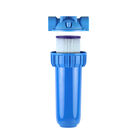
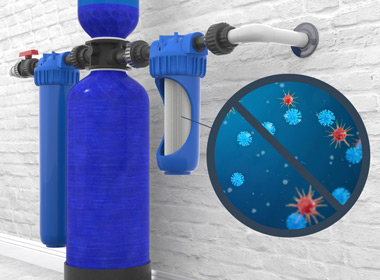
Our EQ-WELL-UV Well Water Whole House Filter comes standard with the Aquasana UV Filter specifically designed to kill bacteria and viruses. For our city water whole house systems (EQ-600 and EQ-1000) that do not come standard with the UV filter, we offer the UV Filter as an add-on item that easily attaches to any of our whole house filter systems.
19. Do I need a licensed plumber to install the whole house filter?
Since most licensed plumbers carry insurance to cover any damages caused by an installation error, having a licensed plumber install the system for you will give you the security that the work was done properly and that the installation is backed up by the plumbing company's insurance plan.
20. Is UV effective against protozoa such as Cryptosporidium and Giardia lamblia?
Yes, as a result of recent findings by academic researchers, it has now been proven that UV is the best available technology to treat these protozoan cysts. In addition, the dose levels required to inactivate these cysts are actually quite low: less than 10 mJ/cm2 for 99.9% reduction of both Cryptosporidium parvum and Giardia lamblia.
21. Why do I need to disinfect my water supply?
Disinfection is recommended for all water supplies that are not protected by a municipal water source. Unfortunately, due to the uncertainties that exist with our current water supplies, we can no longer rely on the fact that our water supplies "may be safe". By providing your own disinfection, you are taking the responsibility of ensuring the safety of your water supply for you and your family.
22. Does UV remove E. coli?
Yes, E. coli requires a UV dose of between 6 to 10 mJ/cm2 to achieve a 4-log (99.99%) disinfection. This is well within the capabilities of our UV systems which actually deliver a minimum of 30 mJ/cm2.
23. Is UV 100% effective?
UV disinfection typically offers a 4-log reduction (99.99%) for both bacteria and most viruses. UV is more effective than chemical disinfection processes at destroying a wide range of viruses.
24. Do I need to disinfect my municipal water supply?
Our municipalities work very hard to provide safe, disinfected water for their customers. This is quite evident when you consider the difficulties involved in providing safe drinking water through a vast distribution network. If you use water that comes from a municipal water supply and wish to provide your family with added "peace of mind", then we believe a UV system acts as an inexpensive insurance policy against the possibility of drinking bacteriologically contaminated water.
26. Will UV change the taste of my water?
No, UV is a physical disinfection process. It does not change the taste or odor of the water. It simply provides safe, reliable disinfection and adds nothing to the water.
27. Should I shut my UV system off when I am not using it?
No, the UV system should be left on whether you are using the water or not. The lamps age regardless of the amount of water drawn through the system. By leaving the unit on, you will eliminate the potential problem of having contamination pass through the system while the unit is off. However, if water is drained from your disinfection system (e.g. winterizing), your UV system must be switched off.
28. What are the annual maintenance requirements?
UV lamps have a useful life of approximately 9000 hours which means that the lamps require annual replacement. The UV light may offer illumination beyond 1 year, however there will not be enough UV energy to provide adequate disinfection. Proper maintenance of any pre-treatment is also required. The sleeve should be cleaned at least once a year.
29. Do I need to consider the quality of my water prior to the UV?
Yes, our UV filter is designed for water that has already been filtered through a home filtration system and not as a standalone unit. For UV to be effective, it is recommended that the influent water contain the following:
• Iron < 0.3 ppm (0.3 mg/L) • Manganese < 0.05 ppm (0.05 mg/L) • Hardness < 7gpg
• Tannins < 0.1 ppm (0.1 mg/L) • Turbidity < 1NTU • UV transmittance > 75%