How lead gets in your water
63 million Americans is a surprising amount of lead exposure – this includes in lead-based paint, as well as your water supply. While the United States government has signed a few measures to help improve water quality across the nation, it’s still hard to know exactly where the primary lead culprit lies.
What we do know is that oftentimes, it comes from below. Even if water starts out lead-free at the original source, it can be contaminated on the way to your tap.
For example, even though the use of lead-based plumbing was banned in 1986, there are still many homes with lead-based piping that has yet to be replaced. And even if your piping system is lead-free, there’s a possibility that your water can pick up lead through municipal pipelines on it’s way to your home.
So, what can you do in the meantime?
The only way to reduce the lead in your drinking water is to use a water filter. However, not all water filters are equal. If you are going to invest in a water filter, you’ll want to make sure it’s the best one available.
Understanding your contaminants
In order to find the best filter for you, you need to know exactly what’s coming out of your tap. Lead isn’t the only contaminant that could be in your drinking water. Treated drinking water can also contain heavy metals such as mercury, and environmental pollutants like pharmaceuticals, herbicides, and pesticides. Plus, the disinfectants used to clean your drinking water are often harsh chemicals like chlorine or chloramines.
You can find out what’s contaminating your water by searching online for a Water Quality Report for your area or contacting your local government. Then find a filter that removes the contaminants that can negatively affect your health or the taste of the water.
Look for the certification
For starters, be sure your filter is certified by a third-party, such as the NSF, WQA, or IAPMO. Groups such as these offer third-party, independent testing and certification, so you know that the filter you’re investing in has been tested and proven to real-world results.
.png)
Getting lead out
Two effective ways to reduce lead in water are reverse osmosis and ion exchange.
Reverse osmosis is the process by which a solvent passes through a porous membrane in the direction opposite to that for natural osmosis when subjected to pressure. Traditional reverse osmosis systems remove nearly everything larger than a water molecule from water, including naturally occurring trace minerals. This process includes the removal of particles like lead, fluoride, arsenic, cadmium, mercury, and asbestos.
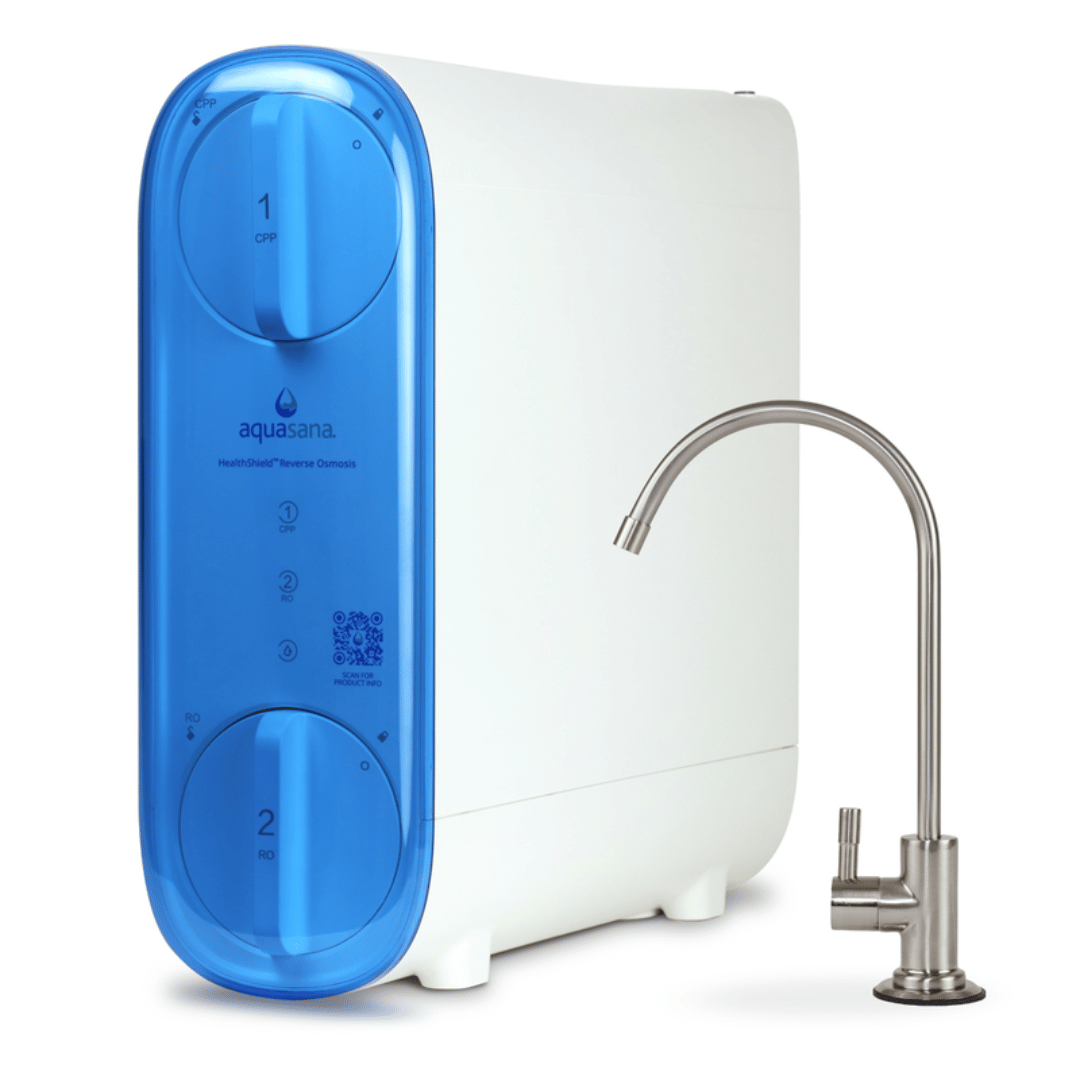
The IAPMO-certified Aquasana HealthShield™ Reverse Osmosis includes two technologies to remove up to 99.99% of contaminants, including fluoride, arsenic, chlorine, and lead. This system can be added at “point of use”, meaning at whatever sink you wish to filter the water for drinking or cooking needs.
Ion exchange is the exchange of ions of the same charge between an insoluble solid and a solution. In water filter terms, that means we use a potassium ion to bond to and grab heavy metal contaminants such as lead from your drinking water.
At Aquasana, we believe that access to high-quality, independently certified water is something everyone should aspire to have. Be your own best advocate and invest in a water filter up to the task of delivering clean, healthy water every time you turn on the tap.
UNDER SINK WATER FILTER
HealthShield™ Reverse Osmosis
The HealthShield™ Reverse Osmosis system delivers powerful, multi-stage filtration in a compact, tankless form — reducing up to 99.99% of select contaminants for cleaner, healthier water at your kitchen sink.